Introduction
Insurance claims investigations depend on evidence.
Claim forms, photographs, invoices, reports, estimates, statements and supporting records can all contribute to understanding what happened. The challenge for claims professionals is not simply having access to that information. It is establishing what the evidence actually supports.
When information is spread across multiple records, inconsistencies can be difficult to identify and important details can require significant manual review. As claim volumes increase, maintaining a structured and consistent investigation process becomes increasingly important.
Artificial intelligence can help, but AI should not become another source of unquestioned conclusions.
At KRM Intelligence, the principle behind the 4CORE AI Engine is straightforward:
Facts first. Evidence always.
4CORE is built around an evidence-led approach in which AI supports the examination of information while people remain accountable for decisions.
The principle is equally simple:
AI is not the final authority. Evidence is.
What Is AI-Powered Evidence Analysis?
AI-powered evidence analysis uses artificial intelligence to assist in examining information and understanding how different pieces of evidence relate to one another.
Within an insurance claim, evidence may include:
- Claim forms and policy information
- Accident or incident reports
- Photographs
- Repair estimates
- Invoices and receipts
- Written statements
- Supporting correspondence
- Other relevant records
Traditional claims investigation can require professionals to examine these sources individually and manually compare important details.
AI can assist with parts of that process.
But the more important question is not simply:
“What does the AI think happened?”
A more evidence-led question is:
“What does the available evidence actually support, and is there anything within that evidence that challenges the apparent conclusion?”
That distinction matters.
Why Insurance Claims Investigation Can Be Challenging
Fragmented evidence
Relevant information may exist across different documents, images and records. Understanding the claim can require those pieces of evidence to be considered together rather than in isolation.
Repetitive review
Claims professionals can spend significant time locating dates, values, descriptions and other relevant information within submitted evidence.
Inconsistent information
Different sources do not always agree.
A date in one document may differ from another. An estimate may not match a subsequent invoice. A description may appear inconsistent with other available evidence.
A discrepancy does not automatically indicate wrongdoing. It does, however, create something that may require examination.
The risk of premature conclusions
A claim can appear straightforward until additional evidence changes the picture.
This is one reason KRM Intelligence places evidence before conclusions.
AI should help professionals interrogate the evidence, not encourage them to accept the first plausible explanation.
How AI-Powered Evidence Analysis Can Support Claims Investigation
1. Bringing Evidence Into a More Structured Review
One of the potential benefits of AI-assisted evidence analysis is helping claims professionals work through large amounts of information more systematically.
Rather than treating every document as an isolated record, relevant information can be considered as part of the wider evidence surrounding the claim.
The objective is not simply to process information faster.
It is to make the evidence easier to examine.
2. Highlighting Material Inconsistencies
Different pieces of evidence may tell different stories.
Consider a claim where an incident report records one date while another submitted record contains a different date.
There may be a perfectly reasonable explanation.
The important thing is that the difference is identified rather than overlooked.
AI-assisted analysis can support this process by bringing potentially relevant inconsistencies to the attention of the claims professional.
The person investigating the claim can then return to the original evidence and determine what the discrepancy actually means.
This reflects an important KRM Intelligence principle:
Behaviour before labels.
Something should not be treated as suspicious simply because it has been labelled that way. The underlying evidence and what it actually demonstrates should be examined first.
3. Supporting Evidence-Led Investigation
There is an important difference between using AI to produce an answer and using AI to support an investigation.
KRM Intelligence’s approach is based on the second.
A useful evidence system should help a claims professional examine what is known, identify what may conflict and recognise where further human examination may be required.
This creates a healthier relationship between people and AI.
The AI contributes analytical support.
The evidence remains available for examination.
The professional remains accountable for the decision.
4. Challenging What Appears to Be True
Evidence analysis should not only look for information that supports an initial position.
It should also be capable of challenging it.
This principle sits at the heart of the KRM Intelligence Standard:
What evidence would prove us wrong?
That question matters because AI, like people, can reach an incorrect interpretation.
A responsible evidence-led approach therefore needs to consider contradictory information rather than simply reinforcing an existing conclusion.
For insurance claims investigation, this can help create a more balanced approach to reviewing complex or conflicting evidence.
5. Keeping Human Judgement in the Process
AI can assist with analysis, but responsibility should remain with people.
4CORE is not based on the idea that an AI-generated answer should automatically determine the outcome of a claim.
Instead, the objective is to help the professional understand the evidence more clearly.
Where evidence conflicts, where information is incomplete, or where something requires further investigation, those issues should be available for human consideration.
People remain accountable.
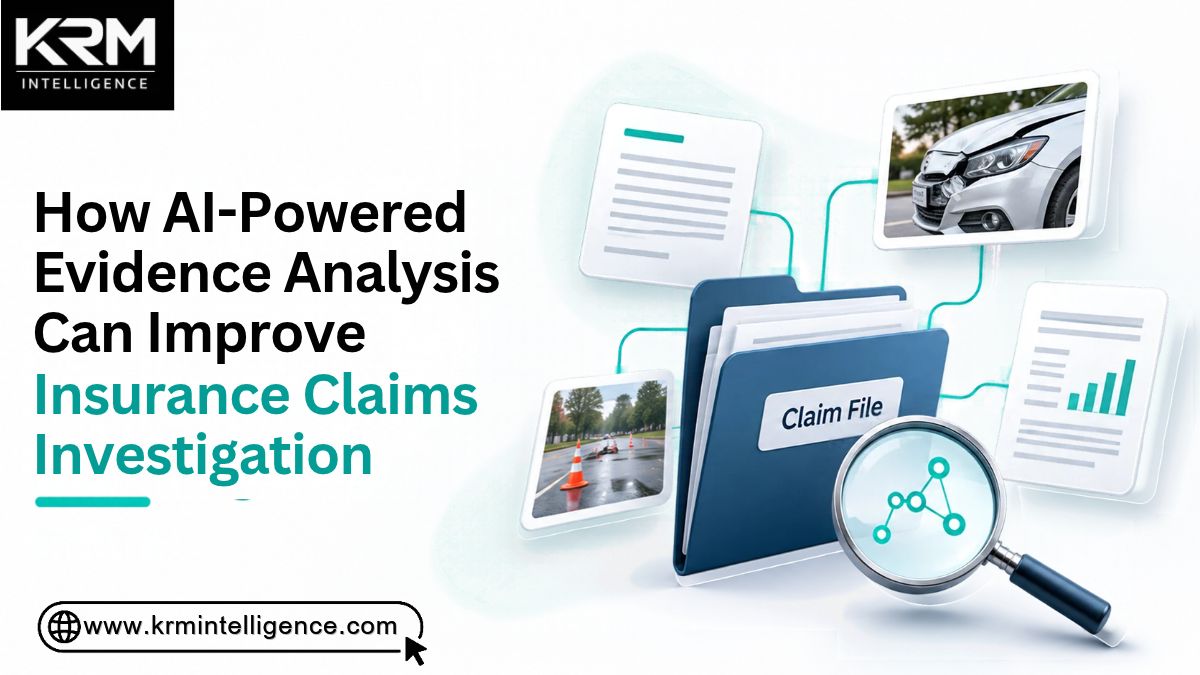
A Practical Example: Investigating a Motor Insurance Claim
Imagine a motor insurance claim containing:
- Accident photographs
- An incident report
- A repair estimate
- An invoice
- Supporting documentation
A reviewer needs to understand how those pieces of evidence fit together.
During the investigation, the repair invoice may differ from the original estimate.
That difference alone does not prove anything.
Additional work may have been authorised. The estimate may have changed. Further damage may have been identified. There may be another reasonable explanation.
The important point is that the discrepancy should not simply disappear within the volume of information.
An evidence-led AI process can help bring the difference forward for examination.
The claims professional can then review the relevant evidence, establish the circumstances and decide what action, if any, is appropriate.
The AI identifies something worth examining. The evidence helps establish what it means. The person remains responsible for the decision.
Where 4CORE Is Different
There are many uses of artificial intelligence within insurance.
Some focus on automation. Others focus on document extraction, prediction, scoring or workflow.
KRM Intelligence developed the 4CORE AI Engine around evidence.
The underlying philosophy is:
- Truth Over Assumptions
- Evidence Before Conclusions
- Behaviour Before Labels
- Challenge What Appears True
- Even AI Gets Questioned
- People Remain Accountable
- Real-World Value Must Justify Complexity
Together, these principles form the basis of how KRM approaches the use of AI.
The objective is not to make AI the authority within an investigation.
It is to use AI to help professionals examine evidence in a structured way while retaining the ability to question the analysis itself.
That distinction is important.
If AI is going to play a greater role in insurance decisions, its conclusions should not be accepted simply because they were produced by an algorithm.
They should remain open to challenge against the evidence.
Evidence, Not Assumptions
One of the risks surrounding artificial intelligence is the temptation to confuse a plausible answer with a proven answer.
They are not the same thing.
An explanation may sound convincing while still being unsupported by the available evidence.
For that reason, KRM Intelligence takes a deliberately evidence-led position:
Facts before assumptions.
This means establishing what is known before moving towards interpretation and clearly recognising where the available evidence does not support a definitive conclusion.
That principle is relevant far beyond insurance, but claims investigation provides a particularly clear example of why it matters.
Decisions can have real consequences.
The standard applied to the evidence therefore matters.
AI Should Be Questioned Too
Human investigators can make mistakes.
Artificial intelligence can make mistakes as well.
Introducing AI into an investigation should therefore not mean replacing one unquestionable opinion with another.
4CORE’s philosophy deliberately treats AI as something that can be challenged.
Where the evidence contradicts an AI-generated interpretation, the evidence takes priority.
That is the meaning behind one of KRM Intelligence’s central rules:
AI is not the final authority. Evidence is.
Conclusion: Make Every Piece of Evidence Count
AI has the potential to support insurance claims professionals by helping them work with complex evidence and bring important inconsistencies or unanswered questions into focus.
But speed and automation alone should not define successful insurance AI.
The more important question is whether technology helps people reach decisions that can be justified by the evidence.
That is the philosophy behind the KRM Intelligence 4CORE AI Engine.
Facts first. Evidence always.
AI can assist the investigation.
Evidence supports the conclusion.
People remain accountable for the decision.
Explore the KRM Intelligence 4CORE AI Engine to learn more about KRM’s evidence-led approach to artificial intelligence in insurance.
Frequently Asked Questions
What is AI-powered evidence analysis in insurance?
AI-powered evidence analysis is the use of artificial intelligence to assist with examining information connected with an insurance claim and help professionals identify relevant relationships, inconsistencies or areas requiring further examination.
Can AI determine whether an insurance claim is fraudulent?
AI may assist an investigation by identifying information that warrants further examination, but an unusual feature or inconsistency does not by itself establish fraud.
Evidence must be considered within the circumstances of the individual claim, and appropriate human investigation and judgement remain essential.
Does 4CORE replace insurance claims investigators?
No. The 4CORE approach is based on supporting evidence-led investigation rather than removing human accountability.
AI can assist with analysis, but people remain responsible for assessing the evidence and making appropriate decisions.
What makes the 4CORE approach different?
4CORE is built around the KRM Intelligence evidence philosophy.
Rather than treating AI as the final authority, the approach prioritises facts, evidence, contradiction checking and human accountability.
The central principle is:
AI is not the final authority. Evidence is.
Why should AI-generated conclusions be challenged?
AI can produce incorrect interpretations just as people can make incorrect judgements.
An evidence-led approach therefore asks whether the available evidence supports the conclusion and whether contradictory information exists.
KRM Intelligence expresses that challenge with a simple question:
What evidence would prove us wrong?