Introduction
Insurance businesses often deal with large amounts of information spread across documents, invoices, photographs, reports and other records. Understanding how these pieces of information relate to one another can be time-consuming, particularly when decisions depend on accurate, supporting evidence.
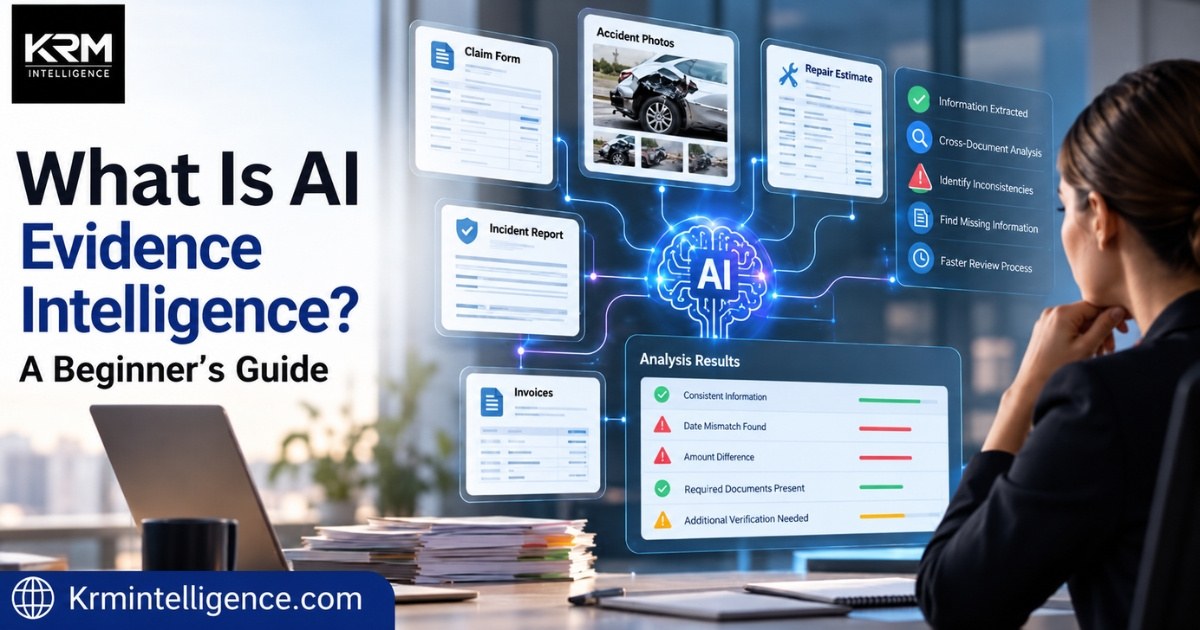
Imagine an insurer reviewing a claim that includes an incident report, a repair estimate, photographs and invoices. Each document contains useful information, but the claims team must review the details, compare records and flag anything that needs clarification.
This is where AI evidence intelligence can help. By using artificial intelligence to organise, analyse and connect information from different sources, businesses can make evidence easier to review and identify potential inconsistencies more efficiently.
In this guide, we explain what KRM AI evidence intelligence is, how it works, where it can be used and how insurance businesses may benefit.
What Is AI Evidence Intelligence?
An KRM AI evidence intelligence uses artificial intelligence to analyse information from multiple sources and turn it into structured insights that support investigations and decision-making.
Evidence may include documents, financial records, photographs, reports, written statements and digital communications. Reviewing each item separately can make it difficult to see the full picture.
AI evidence intelligence brings relevant information together, making it easier to identify relationships, missing details, conflicting information and areas that may need further investigation.
Why Is AI Evidence Intelligence Important?
Evidence-gathering processes often involve repetitive tasks, fragmented information and the risk of human error. AI evidence intelligence can help businesses address several challenges.
1. Finding information more easily
Employees may spend considerable time searching documents for specific dates, amounts, statements or references. AI can extract and organise these details so they are easier to find.
2. Identifying inconsistencies
Comparing information across several records manually can be difficult. AI evidence analysis can help highlight differences that require further investigation.
3. Identifying missing information
Where a process has defined documentation requirements, AI can help flag potentially missing forms, reports, photographs or supporting records.
4. Reducing repetitive work
Automating tasks such as information extraction, document classification and basic comparisons can allow employees to focus on more complex investigations.
5. Supporting traceable reviews
A well-designed system can link findings to their original sources, helping reviewers understand where information came from and check its accuracy. These benefits depend on the quality of the evidence, the technology’s capabilities and the review procedures the organisation establishes.
How Does AI Evidence Intelligence Work?
An AI evidence intelligence workflow commonly involves the following stages.
1. Collecting evidence
The process begins by gathering relevant records, such as claim forms, invoices, photographs, reports and other supporting documents. The organisation should ensure that the information is relevant to the case and that its use is properly authorised.
2. Extracting information
AI document analysis helps identify and extract useful information from digital files and scanned documents. Optical character recognition (OCR) can convert scanned text into machine-readable information, while natural language processing and language models can help interpret the extracted content. Information may include dates, amounts, reference numbers, descriptions and statements.
3. Organising the information
Extracted details can be organised by case, document type, date or other relevant attributes. This gives reviewers a more structured view of the available evidence, rather than requiring them to search every document individually.
4. Comparing information across sources
AI-powered evidence analysis can compare details across records and flag potential discrepancies. For example, if an incident report gives a different date from the claim form, the system may highlight the difference and direct the reviewer to the relevant documents.
5. Highlighting potential issues
Depending on its configured capabilities, a system may identify missing information, conflicting details, duplicate records or unusual patterns. These findings should be treated as indicators for review, not as automatic proof of wrongdoing.
6. Supporting human decisions
Finally, the system presents its findings so that a reviewer can examine the original evidence, investigate unresolved questions and decide on the appropriate next steps. The aim is to make evidence easier to understand without removing human accountability.
AI Evidence Intelligence vs AI Document Analysis
These terms are related, but they describe different capabilities.
| AI document analysis | Extracting and interpreting information within documents. |
| AI evidence verification | Checking information against relevant sources, requirements or supporting evidence. |
| AI evidence intelligence | Connecting information across sources to help identify relationships, gaps and findings. |
How Can Insurance Businesses Use AI Evidence Intelligence?
The insurance industry is very vast, and it is a strong use case because claims often involve multiple documents, different parties, and information collected at different stages.
Insurance claims processing
AI can help organise submitted documents, extract relevant information and identify potentially incomplete records. This helps claims teams understand what has been provided and what may need additional attention.
Insurance fraud investigations
AI fraud detection can help identify suspicious patterns and inconsistencies across claim documents and supporting evidence. Investigators can review these findings to decide whether further investigation is warranted.
Document verification
Insurers can use AI-assisted workflows to check whether applicants have submitted the required documents and whether information across records is consistent. Document authenticity may require additional verification methods.
Practical Example: Reviewing a Motor Insurance Claim
Imagine a policyholder submits a motor insurance claim with photographs, an incident report, a repair estimate and an invoice. A manual review requires an employee to open each file, locate relevant details and compare the information.
An AI evidence intelligence workflow could help by:
- Collecting the submitted documents under the relevant claim.
- Extracting dates, amounts and incident descriptions.
- Comparing the repair estimate with the invoice.
- Flagging a difference between the two amounts.
- Showing the reviewer the relevant source documents.
- Allowing the claims professional to investigate and determine the appropriate outcome.
The difference could have a legitimate explanation, such as additional repair work. AI helps identify the issue; the reviewer establishes its significance.
What Should Businesses Consider Before Adopting AI Evidence Intelligence?
Before selecting an AI evidence intelligence solution, businesses should evaluate several factors.
- Accuracy: Can the system reliably extract information from the documents the business actually uses?
- Cross-document analysis: Can it compare information across multiple sources?
- Traceability: Can reviewers connect findings to the original evidence?
- Data security: Are access controls, retention policies and data-processing arrangements appropriate?
- Human oversight: Can employees review, correct and challenge automated findings?
- Performance measurement: Can the organisation test accuracy, false alerts, missed discrepancies and time saved?
Successful implementation requires more than automation. It needs appropriate safeguards, clear workflows and measurable business objectives.
How KRM Intelligence and the 4Core Engine Fit In
For organisations exploring AI in insurance, the next step is to understand how a specific product supports their evidence-related workflows. KRM Intelligence’s 4Core Engine is its core product and should be assessed in the context of the business problem an insurer needs to solve.
The most useful starting point is to identify the challenges a team faces today. Are employees spending too much time reviewing documents? Is information scattered across multiple records? Are discrepancies difficult to identify consistently? Answering these questions can help businesses determine where AI-assisted workflows may offer value.
Frequently Asked Questions
What is AI evidence intelligence in simple terms?
AI evidence intelligence uses artificial intelligence to organise and analyse information from different sources, helping people identify relevant details, inconsistencies and missing information.
Can AI evidence intelligence detect insurance fraud?
Yes, AI can highlight suspicious patterns and inconsistencies that warrant investigation.
Does AI evidence intelligence replace human reviewers?
No. It can support repetitive tasks and help prioritise reviews, while people remain responsible for interpreting context and making appropriate decisions.
What is the difference between evidence intelligence and document analysis?
Document analysis focuses on extracting and interpreting information from documents. Evidence intelligence takes a broader approach by connecting information across sources and highlighting relationships or discrepancies.
Is AI evidence intelligence useful outside insurance?
Yes. Similar approaches may support compliance reviews, auditing, financial investigations and other processes involving large amounts of evidence.